
Well-organised content structure is the foundation of Google search engine optimisation
Google still processes the vast majority of the world's search traffic, and that makes Google search engine optimisation the single most impactful channel for driving sustainable website traffic. Whether you run a local shop or manage a global brand, understanding how search engines work and what Google rewards in 2026 is the difference between being found and being invisible.
This guide breaks down exactly what website owners need to know right now: from on page seo and technical seo to off page seo, content strategy, and the new AI-driven features reshaping the way typical Google search results look and behave.
Key Takeaways
- Google holds roughly 90% of the global search market share in 2026, making it the dominant search engine and the primary focus of any serious SEO campaign. Search engine optimisation remains one of the highest-ROI channels for long-term organic traffic growth.
- Successful Google SEO combines on page seo (content, HTML, internal links), technical seo (crawlability, speed, security), and off page seo (backlinks, mentions, reviews), all aligned with user search intent and Google's published guidelines.
- Google Search Console and a fully optimised Google Business Profile are must-have tools for monitoring search visibility, diagnosing indexing issues, and strengthening local seo performance.
- High-quality content, fast and mobile-friendly web pages, and descriptive URLs remain core ranking factors, even as AI Overviews and generative search features expand across the SERP.
- SEO can take 3-6 months to show significant results. Meaningful ranking improvements require consistent, iterative work rather than a one-time quick fix.
What Is Google SEO Optimisation?
Google SEO involves enhancing a website to rank higher in search results across Google Search, Google Images, Google Maps, and other Google surfaces. At its core, search engine optimization seo is the practice of making individual web pages and entire sites more useful, discoverable, and trustworthy so that search engines discover them and present them to the right audience.
SEO began in the mid-1990s with early search engines, and the discipline has evolved enormously since then. As of 2026, Google still handles approximately 90% of global web searches, making it the search engine that nearly every SEO campaign targets first.
SEO is unpaid and focuses on organic search results. This distinguishes it from paid advertising, where sponsored listings appear above organic results. Both matter, but organic traffic tends to compound over time without per-click costs.
SEO includes on-page, off-page, and technical optimisation strategies. Think of it as three pillars:
- On-page: content quality, HTML elements, relevant keywords, internal links
- Off-page: backlinks from other sites, brand mentions, reviews
- Technical: crawlability, indexability, speed, site security
Successful SEO combines relevant content, a technically sound website, and authority. It is not a one-time project. Google's search engine algorithms evolve continuously, competitors publish new content, and features like AI Overviews change how search engine results pages display information. Treating SEO as an ongoing process is the only reliable approach.
How Google Search Works in 2026
Understanding how search engines work behind the scenes helps you make better optimisation decisions. Here is how the Google search engine processes the web in four stages.
Crawling. Web crawlers (also called search engine bots) follow links across the internet and request pages. Googlebot discovers URLs through internal links, external links, and XML sitemaps. You control which pages it can access using your robots.txt file.
Rendering. Google renders JavaScript-heavy pages similarly to a modern Chrome browser. This means single-page applications and dynamic content are largely visible to Google, though clean HTML still renders more reliably.
Indexing. After rendering, Google stores page content along with signals: language, freshness, geographic relevance, Core Web Vitals data, and link structures. Google's mobile-first index prioritizes mobile versions of websites, so whatever your mobile site shows is what Google evaluates.
Ranking. When a user enters a search query, multiple ranking systems evaluate indexed pages for relevance, quality, and usefulness. Google uses over 200 ranking factors to assess web pages, weighing different signals depending on the query type and user context.
Google now also generates AI Overviews for many informational queries, but those generative summaries still depend on the underlying index and traditional ranking signals. Being indexed well and ranking high remains the foundation.
Core Google Ranking Factors You Can Influence
Google's algorithm uses over 200 ranking factors for content quality, but not all carry equal weight for every query. Here are the main categories worth your attention:
| Category | Key Signals | Biggest Impact On |
|---|---|---|
| Content quality & relevance | Helpful content, search intent match, originality | All queries |
| Technical health | Page speed, HTTPS, mobile-friendliness, crawlability | Baseline eligibility |
| User experience | Core Web Vitals, low bounce rate, engagement | Competitive queries |
| Authority & links | Quality backlinks, brand mentions, E-E-A-T | Competitive & YMYL queries |
Factors are query-dependent. Location matters more for "near me" searches, freshness for news queries, and depth plus authority for YMYL (Your Money or Your Life) topics like health and finance.
SEO focuses on relevance, user experience, and trust. User experience impacts site credibility and affects bounce rates, which is why a well-designed site increases user trust and retention. Your strategy should prioritise user value first, then optimise for how Google measures that value.
Page speed is a confirmed Google ranking factor. Mobile optimisation is crucial as mobile searches exceed 60% of all Google search traffic. These are not optional extras; they are baseline requirements.
The sections below dig into each category with specific, actionable recommendations.
On Page SEO: Optimising Individual Pages for Google
On-page SEO focuses on optimising individual web pages so that Google can understand what each page covers and why it deserves to rank. This includes both the visible content and the HTML signals behind it.
Map each page to intent. Every page should target one primary keyword and a cluster of closely related phrases. Analyse current Google search results for your target term to understand search intent: is Google showing guides, product pages, comparison tables, or local results? Match that format.
Title tags. Each title tag should be unique, 50 to 60 characters, with the primary keyword near the front. A good title signals relevance to both Google and internet users scanning search results.
Meta descriptions. Write a good meta description that acts as a compelling summary. While not a direct ranking factor, it directly influences click-through rate from search engine results pages.
Headings and structure. Use one clear H1 per page, then organise content with H2 and H3 subheadings. This helps search engines understand your page content hierarchy and makes the page scannable for readers and screen readers alike.
Internal links. Link to relevant pages within your site using descriptive anchor text that mirrors real search behaviour. Internal links distribute authority and help Google discover related content across your site.
Image alt text. Write alt text that describes the image accurately. This supports accessibility, and it helps search engines understand visual content on the page.
Every page should provide a better answer than the competition. If your content does not clearly outperform what already appears in Google search results for that topic, it will struggle to earn and hold a top position.
Technical SEO for Google Crawling and Indexing
Technical SEO ensures a website is crawlable and indexable by search engines. Without it, even the best content may never appear in search results.
Robots.txt and sitemaps. Your. txt file controls which areas of your site web crawlers can access. Sitemaps help search engines discover and index website pages more efficiently. Submit your XML sitemap through Google Search Console for faster discovery.
Canonical tags and status codes. Use canonical tags to tell Google which version of a page is the primary one. Return proper status codes: 200 for live pages, 301 for permanent redirects, 404 for removed pages. Incorrect codes confuse search engine bots and waste crawl budget.
Mobile-first indexing. Mobile responsiveness is crucial as Google uses the mobile version for indexing. Ensure your mobile site contains the same content, structured data, and metadata as the desktop version. Mobile devices account for over 60% of Google searches, so a broken mobile experience directly harms your search engine rankings.
Page speed. Pages that load in under 2 seconds benefit most in rankings. Pages loading under 2 seconds improve user experience and rankings simultaneously. Optimise with image compression, lazy loading, caching, and code minification. Current Core Web Vitals thresholds require LCP ≤ 2.5 seconds, INP ≤ 200 milliseconds, and CLS ≤ 0.1.
HTTPS. Site security via HTTPS is a confirmed ranking signal. Ensure your entire domain runs on HTTPS with no mixed content.
Structured data. Structured data markup helps search engines understand website content better. Use schema.org vocabulary for products, FAQs, local businesses, and how-to guides. Structured data enables rich results in search results, which can improve click-through rates significantly.
Site Structure, Navigation, and Descriptive URLs
Logical site architecture helps both users and most search engines understand how your pages relate to one another.
Hierarchy matters. Organise your site from broad to specific: home → category → subcategory → detail page. This mirrors how people browse and how Google interprets topical relationships.
Shallow click depth. Important pages should be reachable within three clicks from the homepage. Deeper pages get crawled less frequently and tend to accumulate less authority. Use breadcrumb navigation (with structured data) to reinforce hierarchy.
Descriptive URLs. Compare /seo/google-search-console-guide/ with /post?id=1234. Descriptive urls communicate topic relevance to both users and search engine bots, and they can appear as breadcrumbs in Google search. Keep them concise, lowercase, and hyphen-separated.
Topical folders. Group related pages into folders like /blog/seo/ or /blog/analytics/. This signals topical relevance to Google and helps organise your internal linking.
Duplicate content management. Handle duplicates with canonical tags and 301 redirects. Common culprits include filter parameters, HTTP vs. HTTPS versions, www vs. non-www variants, and paginated URLs serving multiple URLs of similar content. Consolidating all the URLs that serve duplicate content into a single canonical version prevents diluted rankings.
High Quality Content That Google Wants to Rank
High-quality content in Google's framework means original, helpful, accurate information written for people first, not search engines. Google recommends that SEO efforts focus on creating content for people first, and Google prioritises content that solves problems to increase user engagement.
Align with search intent. High-quality content aligns with user search intent. Before writing, check what currently ranks: if Google shows step-by-step guides for a query, a product page will not rank there. Use SERP analysis to determine whether informational, commercial, transactional, or navigational content is expected.
Depth over length. Longer is not automatically better. Cover the topic comprehensively with clear structure, examples, and current data, but cut filler. A 1,200-word article that directly answers the question outperforms a 4,000-word article padded with generic advice.
Visuals and engagement. Include images, charts, and real-world examples. These improve dwell time and perceived usefulness. Content should be original and useful to improve SEO rankings, which means adding unique insights, proprietary data, or first-hand experience that generic AI-generated pages cannot replicate.
Freshness. Updating content regularly can improve search engine visibility. Pages with outdated statistics or broken references signal neglect to both users and Google. Revisit your top-performing content at least annually.
The easiest way to differentiate your content: include something a competitor cannot easily copy, whether that is original research, a unique case study, or genuine practitioner experience.
E‑E‑A‑T: Experience, Expertise, Authoritativeness, Trustworthiness
E-E-A-T stands for Experience, Expertise, Authoritativeness, and Trustworthiness. Google's quality rater guidelines (updated December 2022) use E-E-A-T to evaluate whether content and creators deserve to rank, especially for YMYL topics like health, finance, and legal advice.
Google's E-E-A-T guidelines emphasise user experience for content quality. Here is how to demonstrate each element:
- Experience: Share first-hand knowledge. If you are writing about a tool, show that you have used it. Include screenshots, personal observations, and lessons learned.
- Expertise: Display credentials through detailed author bios, professional qualifications, and links to published work on other sites.
- Authoritativeness: Earn mentions and citations from reputable industry sources, associations, and media. Consistent branding across platforms reinforces recognition.
- Trustworthiness: Provide clear contact information, privacy policies, and HTTPS. Make verifiable claims with dated sources. Include update notes on articles to show content is maintained.
For YMYL content, these expectations are especially strict. A medical advice page written by an anonymous author with no cited sources will struggle regardless of how well-optimised the rest of the page is.
Off Page SEO: Building Authority Beyond Your Site
Off-page SEO builds a website's authority through external signals: links, mentions, reviews, and brand visibility across social media platforms, forums, and industry publications.
Backlinks remain essential. Backlinks are considered "votes" of confidence by Google. High-quality backlinks significantly boost your page's rankings. Quality backlinks from reputable domains build your authority far more effectively than hundreds of low-quality links from irrelevant sites.
Sustainable link building approaches:
- Digital PR and data-driven studies that journalists cite
- Guest articles on relevant industry publications
- Creating genuinely useful tools and resources worth citing
- Forum posts and community participation where your expertise adds value
Beyond links. Brand searches in Google, a strong review profile, and consistent NAP citations (name, address, phone) for local businesses all contribute to off-page factors that influence rankings.
Avoid manipulation. Link farms, automated comment spam, and purchased links risk manual actions or algorithmic penalties. Building authority requires ongoing SEO efforts, not a one-time fix, and definitely not shortcuts that violate Google's guidelines.
High-quality backlinks improve a site's authority and ranking over time, but the key word is "over time." Link building is a long game, not a sprint.
Local SEO and Google Business Profile
Local seo optimizes your presence for queries with geographic intent, helping your business appear in Google Maps, local packs, and localised local search results.
Google Business Profile. An accurate and complete Google Business Profile is critical. Fill in every field: business name, address, phone number, hours, categories, and photos. Incomplete profiles lose visibility to competitors who take the time to get this right.
What drives local rankings:
| Factor | What It Means | How to Improve |
|---|---|---|
| Relevance | How well your business matches the query | Accurate categories, detailed descriptions |
| Distance | Physical proximity to the searcher | Serve your area, use location in content |
| Prominence | Overall reputation and visibility | Reviews, citations, backlinks, brand awareness |

Local SEO helps your business appear in Google Maps and local search results
Reviews and engagement. Both the quantity and recency of reviews matter. Respond to every review, positive or negative. Post updates regularly, answer questions in your Q&A section, and keep seasonal hours accurate.
NAP consistency. Ensure your name, address, and phone number are identical across all directories and citation sources. Inconsistencies confuse Google and dilute your local authority.
Localised content. Create dedicated landing pages for each service area or location. Reference local landmarks, neighbourhoods, and relevant community topics. Use internal links between these pages and your main site to strengthen topical connections.
Using Google Search Console for SEO Optimisation
Google Search Console is a free tool that every site targeting Google search should verify and monitor. It provides direct data from Google about how your site performs in search results.
Key reports to use:
- Performance: Shows which queries drive impressions and clicks, your average position, and click-through rate by country and device. This is the most direct view of your search visibility in Google.
- Indexing (Coverage): Identifies which pages are indexed, excluded, or have errors. Catch crawl problems before they hurt rankings.
- Page Experience / Core Web Vitals: Flags URLs failing LCP, INP, or CLS thresholds based on real user data.
- Enhancements: Shows structured data validation, sitelinks, and schema type statuses.
Practical uses:
- Submit your XML sitemap so search engines discover new and updated pages faster
- Request indexing for important new URLs
- Diagnose drops in organic traffic by comparing date ranges and filtering by page, device, or country
- Identify pages with high impressions but low CTR, signalling a need for better title tags and meta descriptions
Monthly routine. Set a calendar reminder to check Search Console at least once per month. Review impressions and click trends, look for new indexing errors, and examine any mobile usability warnings. Tracking metrics like impressions, clicks, rankings, and indexing status helps refine SEO strategy over time.
Use query data to discover content opportunities: if people find your site for queries you have not dedicated a page to, that is a clear signal to create one.
Keyword and Topic Research for Google Search
Effective Google search engine optimisation starts with understanding how real internet users phrase their queries. Keyword research involves identifying specific terms users type into Google, including long-tail and question-based search queries.
Data sources. Combine keyword tools with Google's own data: autocomplete suggestions, People Also Ask boxes, related searches at the bottom of results, and your own search console query reports. These reflect actual search behaviour rather than estimated volumes.
Topic clusters. Group related queries into clusters. Map them to pillar pages (broad topics) and supporting articles (specific subtopics). This structure builds topical authority and helps Google understand the breadth of your expertise.
Prioritisation criteria:
- Search volume (enough demand to justify content creation)
- Competition in current SERPs (can you realistically compete?)
- Business relevance (will this query bring leads, sales, or signups?)
- Intent match (does the query align with what you offer?)
Update keyword research at least annually. New terms enter common use regularly: "AI SEO," "generative engine optimisation," and "answer engine optimisation" are examples from the seo industry in 2025-2026 that barely existed a few years earlier.
Content Planning, Publishing, and Internal Linking
Turn your keyword and topic research into a content roadmap. Map out articles, landing pages, and resource hubs on a calendar so publishing stays consistent rather than reactive.
Balance content types:
- Evergreen: Guides, FAQs, glossaries that remain useful for years
- Timely: Algorithm update analyses, industry news, annual trend reports
Internal linking strategy. Internal links signal importance and topical relationships to Google. Use descriptive anchor text that mirrors real search queries. Link from high-authority pages to newer or deeper content to distribute ranking power.
Effective internal linking includes:
- In-text contextual links to related articles
- Navigation links to category hubs
- Breadcrumb links reinforcing hierarchy
- Footer links to critical pages (sparingly)
Avoid cluttered site-wide link blocks that add dozens of links to every page. These dilute the value of each link and can look spammy.
Content refresh cycles. Updating content regularly can improve search engine crawling frequency. Revisit top pages every 6 to 12 months. Update statistics, fix broken links, add new sections if the topic has evolved, and remove outdated information.
Measuring SEO Success: Metrics and KPIs
Monitoring performance and identifying issues is essential in an ongoing SEO process. But knowing which numbers matter prevents you from chasing vanity metrics.
Primary metrics to track:
| Metric | Source | Why It Matters |
|---|---|---|
| Impressions & clicks | Search Console | Direct measure of search visibility |
| Average position | Search Console | Tracks ranking movement |
| Organic sessions | Google Analytics | Volume of visitors from search |
| Conversions | Google Analytics | Ties SEO to revenue/leads |
| Bounce rate & time on page | Google Analytics | Engagement quality signals |
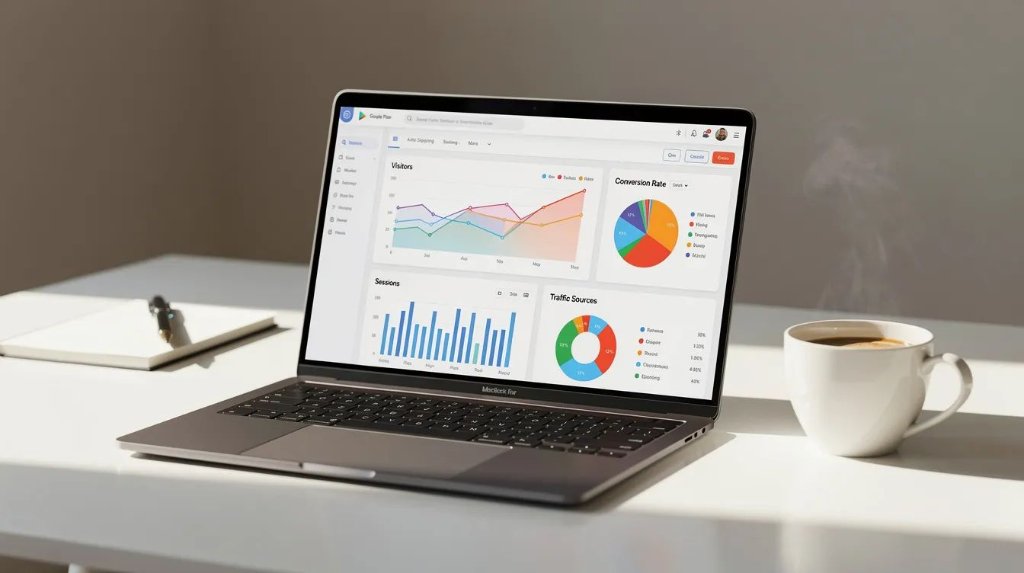
Track impressions, clicks, organic sessions, and conversions to measure Google SEO success
Separate vanity from business metrics. Ranking #1 for one keyword is meaningless if it does not generate leads, sales, or signups. SEO success should be measured against actual business outcomes.
Reporting cadence. Build simple monthly or quarterly reports comparing current performance against the previous period and the same period last year. Segment by:
- Branded vs. non-branded traffic
- Device type (mobile vs. desktop)
- Content categories or page types
Because SEO is long-term, trends over several months matter more than week-to-week fluctuations in Google search results. Expect volatility around algorithm updates and measure progress in quarters, not days.
Timelines, Maintenance, and Algorithm Updates
SEO can take three to six months to show meaningful results on established sites. New sites or highly competitive topics can take 6 to 12 months to achieve strong search engine rankings. Long-tail or niche queries may see traction earlier.
Algorithm updates. Google rolls out broad core updates (roughly annually) and smaller targeted updates throughout the year. The May 2026 core update shifted signal weights but kept the same fundamental quality categories. These updates can cause traffic fluctuations even when you follow best practices.
Maintenance routine:
- Quarterly technical audits (crawl errors, broken links, mobile issues)
- Monthly search console checks for indexing problems and manual actions
- Biannual content reviews for top-performing pages
- Ongoing monitoring of competitor movements and SERP feature changes
When a core update hits, resist the urge to make panicked changes. Instead, review Google's guidance, analyse which sections gained or lost visibility, and focus on improving quality rather than chasing loopholes.
Consistent, iterative optimisation usually wins over reactive, short-term tactics aimed at exploiting temporary ranking gaps.
Google SEO vs. SEM and PPC
Search engine marketing is the umbrella that includes both SEO (organic) and PPC (paid search, such as ppc ads through Google Ads). SEO is unpaid and focuses on earning visibility through quality content and structure. PPC requires payment for each click on ads, and those ads appear above organic results in search engines.
Key differences:
| SEO | PPC | |
|---|---|---|
| Cost | Ongoing content/tech investment | Per-click charges |
| Speed | 3-6+ months for results | PPC provides instant traffic but requires ongoing budget |
| Longevity | Compounds over time | Stops when budget stops |
| Trust | Higher perceived trust from users | Clearly labelled as ads |
Combining SEO and PPC improves total online visibility. PPC data, especially high-converting keywords and ad copy that earns clicks, can inform SEO title tags, on-page content, and overall content strategy. This is a practical bridge between digital marketing channels: paid advertising covers gaps while organic rankings build.
This guide focuses on organic Google search optimisation, but most effective seo strategy plans consider both channels together as part of broader search engine marketing.
Adapting Google SEO to AI Overviews and Generative Search
AI Overviews now appear on roughly 60% of English informational queries in the U.S., presenting generative summaries that answer questions directly in the SERP. For many queries, this reduces clicks to organic results by 20 to 30%.

AI Overviews now appear on roughly 60% of English informational queries
What this means for SEO. Appearing as a cited source within AI Overviews depends on strong traditional SEO signals: authoritative, well-structured, and current content. Pages with valid FAQ or HowTo schema markup and top organic positions have higher odds of being cited.
Emerging optimisation concepts:
- Generative engine optimisation (GEO): Structuring content so AI systems can easily extract and cite it
- Answer engine optimisation: Writing clear, concise answers to specific questions at the top of sections, with deeper detail below for click-through readers
Practical steps:
- Use clear headings that match common search queries
- Provide direct, concise answers in the first 1 to 2 sentences under each heading
- Add structured data for FAQs, how-tos, and entities
- Ensure content is factually accurate and sourced, since AI Overviews sometimes surface unsupported claims
Foundational SEO: technical health, E-E-A-T, and helpful content remain the priority. AI Overviews are a layer on top of classic Google search, not a replacement. The sites that appear in AI summaries are, overwhelmingly, the same sites that already demonstrate strong organic authority.
FAQ: Google SEO Optimisation
How often should I update my website for Google SEO?
Critical pages like your homepage, main service pages, and top blog posts should be reviewed every 6 to 12 months. Update statistics, refresh screenshots, fix broken links, and improve clarity wherever possible. Sites publishing fresh, relevant content regularly tend to be crawled more often, which helps new pages and updates appear in Google search faster. You do not need to make minor edits daily; focus on meaningful improvements in quality and completeness.
Do I really need backlinks to rank on Google?
For very low-competition, local, or branded terms, pages can rank with minimal backlinks if content and technical seo are strong. For competitive national or international seo topics, quality backlinks are usually essential to demonstrate authority. High-quality backlinks significantly boost your page's rankings, but the emphasis is on quality. Earn links naturally through standout resources, partnerships, and digital PR rather than buying links or participating in link schemes.
Is it okay to use AI tools to write Google‑optimized content?
Google's main concern is helpfulness and originality, not the specific tools used. Purely auto-generated, unedited text often fails quality tests because it lacks first-hand experience and nuanced accuracy. Use AI for brainstorming, outlines, and initial drafts, then add human editing, fact-checking, and personal experience to meet E-E-A-T expectations. Avoid mass-publishing thin or duplicative AI content across hundreds of URLs, as this dilutes overall site quality in Google's evaluation.
How can I tell if a Google traffic drop is an algorithm update or a technical issue?
Start by checking Google Search Console for indexing errors, manual actions, or sudden spikes in server errors or 404 pages. If those look clean, compare traffic by device, country, and page type. A broad drop across the entire site often signals an algorithm update, while a drop isolated to specific sections usually points to technical or content issues. Check Google's official Search Status Dashboard and seo industry news sources like Search Engine Land for confirmation of core updates around the date of the traffic change.
How many keywords should I target per page for Google SEO?
Each page should focus on one primary topic or head keyword, plus a cluster of closely related phrases and questions. Google is sophisticated enough to understand variations and synonyms, so the goal is to cover a topic comprehensively rather than cramming dozens of disconnected target keywords into one page. When new keywords represent distinct search intent or subtopics, create separate relevant pages rather than overloading a single URL. This approach builds topical authority and serves users better than keyword stuffing ever could.
Ready to Rank Higher on Google?
Book a free consultation with our SEO team and get a tailored Google optimisation strategy for your business.